

By: Samuel Karim, and Abdul Bero Kamara
Sierra Leone, once symbolized by post-war resilience and democratic recovery, is now teetering dangerously on a new precipice a narcotic epidemic driven by synthetic drugs, most notably Kush. The once-hidden menace has exploded into a full-blown public health and national security crisis. Streets once bustling with hopeful youth now echo with the lifelessness of addiction, while communities grapple with a growing wave of crime, unemployment, and psychological decay.
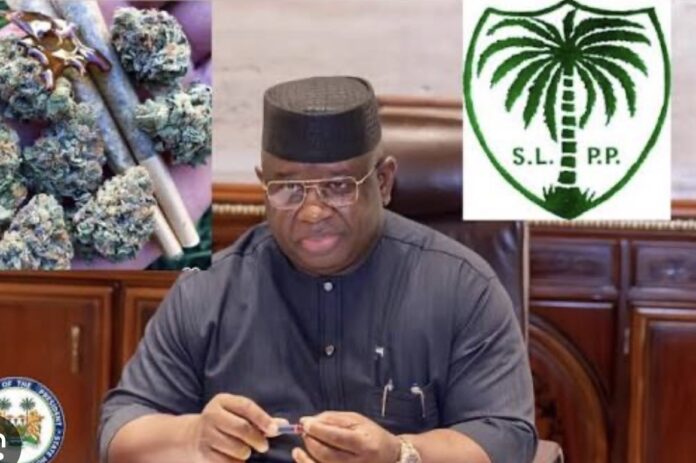
Behind this national decay lies a grim socio-political truth: the failure of the current SLPP government under President Julius Maada Bio to confront the rise of synthetic drug cartels and organized trafficking networks that are slowly turning Sierra Leone into a West African narco-corridor.
Kush is not a mere recreational drug. Scientific analyses conducted across West Africa have revealed that what circulates under this name is often a toxic mixture of synthetic cannabinoids, fentanyl derivatives, formaldehyde, tramadol, and human bones or refuse materials a deadly blend that destroys neurological, respiratory, and reproductive systems. Medical data from Connaught Hospital and other facilities show a staggering increase in drug-related psychosis and sudden deaths among young men between 18–35 years old. Public health experts describe it as “a slow chemical genocide.”
Yet, despite the scale of destruction, policy inertia and institutional complacency have allowed this crisis to metastasize. The streets of Freetown, Makeni, Kenema, and Koidu now mirror the slums of Latin America’s drug-ridden capitals.
Behind the chemical epidemic lies deep social and economic fracture:
1. Youth Unemployment: Over 60% of Sierra Leone’s youth remain jobless or underemployed. Deprivation and hopelessness make synthetic drugs a form of escape.
2. Urban Marginalization: Informal settlements, with no healthcare, policing, or social safety nets, have become breeding grounds for addiction and trafficking.
3. Broken Families and Weak Education: Social collapse at the family level and an education system disconnected from employable skills have created a psychologically vulnerable generation. Kush has therefore become more than a drug it is a symptom of social despair and political neglect.
While the rise of synthetic drugs requires a whole-of-government response, the Bio-led SLPP administration has demonstrated neither the urgency nor the coordination necessary to tackle it.
The National Drug Law Enforcement Agency (NDLEA) remains underfunded and politically undermined. Its presence outside the capital is almost symbolic.
Law enforcement complicity including reports of police officers and local politicians shielding traffickers — has crippled accountability.
Public health responses have been erratic, reactive, and mostly donor-driven rather than state-led.
Policy blindness persists: the administration continues to treat drug addiction as a moral issue rather than a public health and national security emergency.
This failure of leadership mirrors early patterns in Venezuela, Colombia, and Mexico, where governments initially ignored the social and economic infrastructure of narcotics until the cartels became parallel states. Sierra Leone is now dangerously tracing that trajectory.
Investigations and intelligence briefs from ECOWAS and the United Nations Office on Drugs and Crime (UNODC) have identified increasing trafficking routes through Sierra Leone’s porous borders and ports.
With weak maritime surveillance and ineffective customs enforcement, synthetic drug ingredients are reportedly entering the country through Freetown Port, Kambia, and the Guinea–Liberia borderlands. Local “chemists” then produce and distribute Kush in decentralized networks that mimic cartel operations — complete with enforcers, supply chains, and street distribution units. This criminal infrastructure not only fuels addiction but also corrupts governance, enabling money laundering, bribery, and the rise of parallel economies in urban slums. Rather than confronting the crisis, the government has largely resorted to public relations campaigns, moral lectures, and isolated arrests ignoring the systemic corruption and socio-economic despair that feed the drug trade. Rehabilitation centres are few, mostly run by NGOs and churches. The absence of national treatment policy, forensic labs, and community outreach programs exposes a state that is politically awake but operationally asleep.
To reverse this trajectory, Sierra Leone needs more than rhetoric. It requires a scientific, multi-sectoral, and uncompromising national response:
1. Declare a National Public Health Emergency on synthetic drugs, integrating security and mental health strategies.
2. Strengthen the NDLEA and forensic capacities for chemical tracking, customs surveillance, and international cooperation.
3. Launch national rehabilitation programs through partnerships with universities, hospitals, and NGOs.
4. Empower youth through productive employment turning idle energy into innovation rather than addiction.
5. Ensure political accountability, including independent investigations into state collusion with trafficking networks.
Conclusion:
Sierra Leone stands at a defining historical moment. It can either confront its synthetic drug epidemic with courage and science or descend into the same abyss that swallowed parts of Latin America.The Kush crisis is not just a drug problem; it is a mirror reflecting the deep moral, political, and institutional failures of governance. If left unchecked, the country risks losing an entire generation not to war this time, but to chemical enslavement. History will not remember excuses; it will remember whether Sierra Leone acted when it still could.