

BY: SAMUEL KARIM, CHIEF ABDUL BERO KAMARA” (the authors are seasoned academics, researchers, consultants, and socio-political analysts)
22nd Decemeber 2025
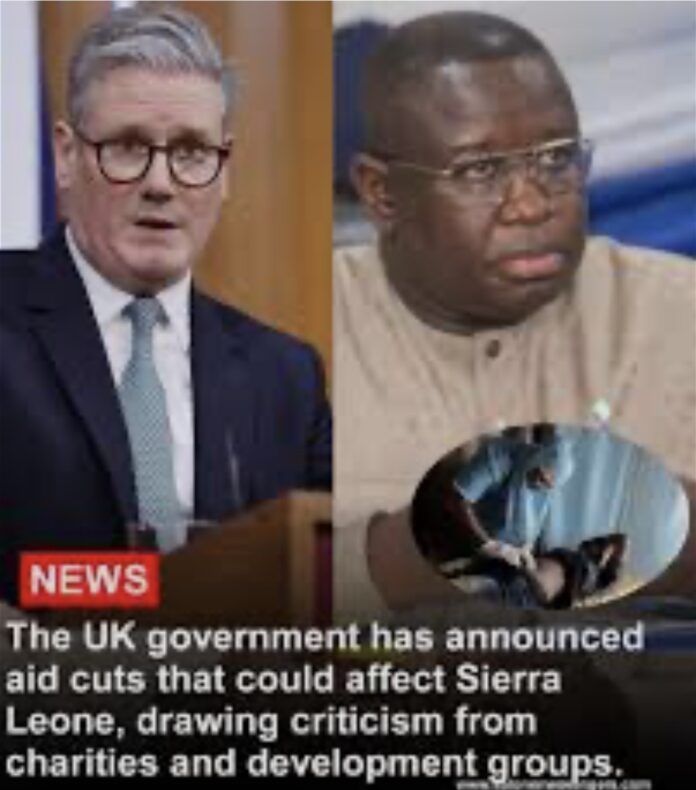
When the United Kingdom quietly reduced foreign aid to Sierra Leone, it did not do so with a dramatic farewell speech or a solemn press conference. It simply packed its bags, turned off the lights, and left the Julius Maada Bio–led government standing at the gate still waving, still smiling, and still pretending nothing happened.
In Freetown, however, the official response was classic: silence, spin, and self-congratulation. According to government logic, the aid cuts are either “a global phenomenon”, “a sign of national maturity”, or my personal favorite “an opportunity.” Opportunity for what, exactly? Opportunity to discover how hollow governance sounds when the donor cheque stops clearing.
For decades, UK foreign aid has been one of the invisible pillars holding up Sierra Leone’s national budget. Health, education, governance reforms many of these programmes survived not on local revenue, but on British goodwill and guilt carefully packaged as development assistance. Now that the tap is being tightened, the question is unavoidable: what exactly remains of the Bio government when foreign budgetary support is removed?
The uncomfortable answer is: not much…!!!!!
The Bio administration has mastered one thing exceptionally well: mistaking donor-funded programmes for government success. When schools were built with foreign money, it was paraded as visionary leadership. When hospitals functioned with donor support, it was sold as policy brilliance. When salaries were paid on time, no one asked whose money it really was.
Now the UK has reduced its aid footprint, and suddenly the emperor’s tailoring is under scrutiny. The grand slogans “New Direction,” “Human Capital Development,” “Transformative Governance “soundless like policy frameworks and more like expired campaign jingles.
Foreign aid cuts do not expose poverty; they expose dependency. And nothing reveals dependency faster than a government that panics when donors blink.
Let us be honest: Sierra Leone’s national budget has long survived on external oxygen. Remove foreign budgetary support and the government begins to gasp. Remove more, and it starts improvising borrowing, taxing air, and blaming “global shocks.”
With UK aid reduced, the Bio government is now left juggling:
I. Rising debt,
II. Weak domestic revenue,
III. IMF conditionalities,
And a population that is increasingly allergic to excuses.
Instead of sober self-reflection, the government has responded with its trademark weapon: public relations gymnastics. Ministers speak confidently about “resilience” while cutting services quietly. Officials promise “local solutions” while boarding international flights to beg new partners.
Perhaps the most tragic comedy is how casually the Bio government downplays the seriousness of the moment because it has grown used to being rescued. Aid cuts are treated like temporary inconveniences, not warning signals.
No emergency parliamentary debates. No national conversation on fiscal reform. No accountability for years of aid-addicted budgeting.
In truth, the UK aid reduction is not merely a financial adjustment; it is a vote of no confidence in governance outcomes. Donors may not say it bluntly, but budgets speak louder than communiqués. Aid does not retreat from countries that demonstrate discipline, transparency, and impact it retreats from systems that recycle excuses.
Ironically, government apologists have framed the aid cuts as a step toward “sovereignty.” But sovereignty without revenue is just independence with overdraft fees. A state that cannot fund its own schools, hospitals, and institutions is not sovereign it is sponsored. The Bio administration wants to be taken seriously on the global stage while running a domestic economy that collapses whenever donors clear their throats. That contradiction is no longer funny it is embarrassing.
What’s Left?
So what remains of the Julius Maada Bio–led government after the UK steps back?
I. A bloated bureaucracy surviving on loans.
II. Development plans waiting for donors to return.
III. Political rhetoric doing the heavy lifting of economic policy.
IV. And citizens expected to endure hardship with patriotic patience.
Foreign aid cuts did not weaken Sierra Leone overnight. They simply removed the makeup, revealing how fragile governance has been beneath the slogans.
The UK may have reduced its aid, but it did Sierra Leone an unintended favour: it exposed a government that had grown too comfortable confusing charity with competence.