

BY: Samuel Karim, and Chief Abdul Bero Kamara
(Consultants, Academics, Researchers, and Socio-Political Analysts)
20th January 2026
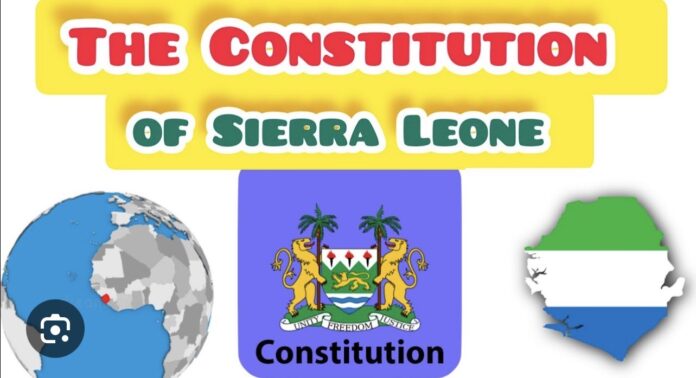
History will not be kind to the Julius Maada Bio–led SLPP government if the proposed 2025 Constitutional Amendments to the 1991 Constitution are forced upon the people of Sierra Leone under the current political climate. These amendments, presented under the deceptive banner of “constitutional reform,” are nothing more than a systematic attempt to weaken democratic safeguards, concentrate executive power, and institutionalize political expediency over national interest.
The 1991 Constitution was born out of pain, struggle, and the collective resolve of a people determined never again to submit to authoritarian rule. It was designed as a shield, not a sword; a document to restrain power, not to indulge it. Yet today, that shield is being deliberately cracked by a government that has increasingly demonstrated contempt for dissent, intolerance for opposition, and impatience with accountability.
True constitutional reform demands consensus, transparency, and moral authority. What we are witnessing instead is a politically engineered process, driven by an SLPP government desperate to rewrite the rules mid-game to compensate for its glaring failures in governance.
At a time when Sierra Leoneans are crushed by:
I. unprecedented economic hardship,
II. rising youth unemployment,
III. food insecurity,
IV. a collapsing health and education system, and
V. deepening tribal and regional polarization,
The Bio administration has chosen to prioritize constitutional tinkering over national survival. This is not reform; it is distraction and manipulation.
One must ask: Why now? Why with such urgency? Why without broad national consensus? The answers are uncomfortable but obvious.
The proposed amendments, in substance and spirit, threaten to tilt the balance of power dangerously toward the Executive. Weakening independent institutions, blurring separation of powers, and normalizing governance by decree is a familiar path in Africa and it always ends the same way: state fragility, democratic decay, and eventual collapse.
A government that has struggled to manage elections without bloodshed, silence journalists without intimidation, or govern without selective justice cannot be trusted with expanded constitutional authority. Power does not correct bad leadership; it exposes it.The Bio-led SLPP government comes to this constitutional conversation with no moral credibility. Its record is stained by:
I. excessive militarization of civil governance,
II. politicization of the judiciary,
III. weaponization of commissions of inquiry,
IV. shrinking civic space, and
V. an alarming intolerance for alternative political voices.
A government that rules through fear cannot be the architect of a people-centered constitution. In moments of national crisis, history demands clarity. The All People’s Congress (APC) remains the only political institution with the historical depth, national character, and ideological clarity capable of rescuing Sierra Leone from democratic collapse.
Unlike the SLPP’s divisive governance model, the APC’s tradition—rooted in national unity, institutional strength, and developmental pragmatism—has consistently demonstrated that state-building requires inclusion, not exclusion; competence, not coercion.
Under APC leadership in the past, Sierra Leone witnessed:
I. infrastructural expansion,
II. institutional rebuilding after war,
III. relative political tolerance, and
IV. a vision of governance that recognized Sierra Leone as one people, one nation, not a collection of political enemies.
The APC understands that constitutions are sacred national compacts, not partisan tools. The 2025 Constitutional Amendments, as currently pursued, represent a fork in the road. One path leads to deeper authoritarianism, institutional decay, and national fragmentation. The other demands resistance, civic awakening, and a return to responsible, people-driven leadership.
Sierra Leone does not need a stronger presidency.
It needs stronger institutions.
It does not need constitutional shortcuts.
It needs competent governance.
And it certainly does not need a government that mistakes power for legitimacy.
If Sierra Leone is to be saved from constitutional vandalism and political collapse, the answer does not lie in cosmetic amendments pushed by an insecure government. The answer lies in restoring trust, rebuilding institutions, and returning power to the people. Today, whether critics like it or not, the All People’s Congress stands as the only viable political force capable of stabilizing the state, defending constitutionalism, and restoring democratic sanity.
The question before Sierra Leoneans is no longer about party loyalty it is about national survival.
History is watching.
The people are watching.
And the future will judge harshly those who chose power over principle.