

By: Samuel Karim, and Abdul Bero Kamara- Chief
20th August 2025
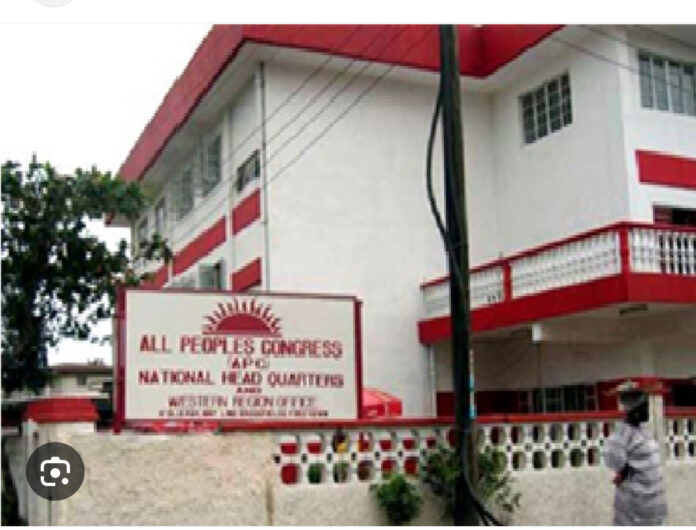
As Sierra Leone marches steadily toward the 2028 General Elections, the political terrain is already being reshaped in subtle yet powerful ways. One of the most striking developments is the creation of more districts in the South-Southeast by the ruling SLPP government under President Julius Maada Bio. At first glance, this redrawing of boundaries seems administrative, perhaps even developmental. But in politics, nothing is ever neutral. The question now is this: what does this mean for the All People’s Congress (APC) and its chances of reclaiming State House in 2028?
The Political Calculus of District Creation
District creation in Sierra Leone has often been coated in the language of decentralization and bringing government closer to the people. Yet, in the chessboard of politics, new districts mean new parliamentary seats, new councils, and fresh voter registers all potential levers of influence. By strengthening the SLPP’s traditional bastions in the South-Southeast, the ruling party may be aiming to cushion itself against the numerical dominance the APC enjoys in the North and Western Area.
This maneuver could shift the balance of power in Parliament, and more critically, shape perceptions of political legitimacy. The SLPP appears to be thinking ahead, designing a future where its grassroots stronghold becomes mathematically harder to crack.
APC’s Historical Advantage
The APC, however, is no stranger to uphill battles. From SiakaStevens’ consolidation of power in the 1970s, to Ernest Bai Koroma’s surprising comeback in 2007, the party has repeatedly demonstrated an ability to defy odds. Its northern base remains loyal, and the Western Area particularly Freetown continues to lean red when ballots are counted.
The Battle for the Centre
The real battleground is not the North or South, but the in-between the youth in urban centers, the undecided voters frustrated with unemployment, corruption, and economic hardship. Sierra Leone’s young population (over 70% under the age of 35) cares less about old regional loyalties and more about bread-and-butter issues: jobs, education, electricity, and healthcare.
For APC to stand a chance in 2028, it must present itself not just as an alternative, but as a credible vision of competence, inclusivity, and reform. If the party falls back into the lazy comfort of regional arithmetic, it risks being checkmated by Bio’s carefully laid district expansion.
Why 2028 Could Still Be APC’s Moment
Yet, politics is not mathematics alone it is also about mood, emotion, and timing. By 2028, Sierra Leoneans will have lived through a decade of SLPP under Maada Bio. Fatigue is a powerful political weapon, and if the economy fails to recover, inflation continues to bite, and governance remains marred by mistrust, voters could be more than ready for a change.
The APC’s biggest opportunity lies in rebranding itself as a party of national unity, justice, and development not just a northern champion. If it can field a candidate who inspires hope, embraces reform, and reaches across regional divides, then no number of new districts can stop its momentum.
Conclusion: Districts Don’t Vote, People Do
The creation of new districts may shape the structure of elections, but it will not predetermine their outcome. Districts do not vote people do. And people, when pushed to the wall by economic hardship, corruption, and hopelessness, often vote for change, regardless of geography.
The APC’s chances in 2028, therefore, will depend not on how many districts the SLPP carves out of the South-Southeast, but on whether the APC can carve out a message strong enough to pierce through despair and ignite a new national movement.
If it rises to the occasion, the APC could remind Sierra Leoneans of one eternal truth of democracy: no boundary is powerful enough to contain the will of the people.